Catalog printing cost is set by four decisions made before a single sheet runs: page count, trim size, paper weight, and binding method. Postage is usually the second largest line on the invoice after paper, and in 2026 it is the line most within your control. The USPS Catalog Insights Promotion takes 10 percent off qualifying catalog postage through June 30, 2026, but only for catalogs that are at least 12 pages, bound, and built around a product list with visuals. Spec the book wrong and that discount is gone before the file reaches prepress.
This guide covers what those decisions actually cost, how the postal rules constrain them, and how far ahead a catalog program needs to start.
Key Takeaways
- The USPS Catalog Insights Promotion offers a 10 percent postage discount on qualifying USPS Marketing Mail catalogs, running October 1, 2025 through June 30, 2026. Requirements: at least 12 pages, bound, product listings with visuals, plus enough ordering and fulfillment information for a reader to place an order.
- Two stackable add-ons, Informed Delivery and Sustainability, can each add roughly 1 percent more, with an extra 0.5 percent available for eDoc submission on Informed Delivery.
- USPS held Mailing Services prices flat in January 2026, so catalog postage did not take a new-year increase. The January 18, 2026 changes hit shipping products instead.
- Page counts drive binding: saddle stitching works to roughly 64 to 88 pages depending on paper bulk, and perfect binding takes over above that.
- Flat-size mail caps out at 12 inches high, 15 inches long, and three quarters of an inch thick. Exceed any of those and the piece reprices as a parcel.
- E-commerce reached 16.9 percent of total U.S. retail sales in Q1 2026, which means roughly 83 percent of retail still happens somewhere a catalog can influence.
What Catalog Printing Costs, and What Actually Drives the Price
Postage, binding, and run-length thresholds for 2026
Source: USPS Mailing Services 2026; Walton Press.
Paper and postage typically account for more of a catalog budget than the printing itself. That surprises most first-time buyers, who assume press time is the big number. It usually is not.
Here is the order of magnitude on a typical 5,000-piece to 50,000-piece run:
| Cost driver | Why it moves the number |
|---|---|
| Page count | Sets paper consumption, press signatures, and binding method all at once |
| Trim size | A 8.5 x 11 book and a 6 x 9 book cut from the same parent sheet very differently |
| Paper weight and coating | Heavier stock raises both paper cost and postage weight |
| Binding | Saddle stitch is cheaper per unit; perfect binding is required past a certain bulk |
| Quantity | Offset makeready is fixed, so unit cost falls steeply as the run grows |
| Mail prep | Presort quality, address hygiene, and promotion eligibility decide postage |
The lever most people ignore is page count parity. Catalogs bind in signatures, usually multiples of 8 or 16 pages. A 66-page book is not 2 pages more expensive than a 64-page book. It is a whole extra signature more expensive. Trimming two pages of white space can be worth several thousand dollars on a mid-size run.
Quantity behaves the same way in reverse. On offset printing, the setup is amortized across the run, so doubling quantity rarely doubles cost.
How to Qualify for the USPS Catalog Insights Promotion
The Catalog Insights Promotion is the highest-value program on the 2026 USPS calendar at a 10 percent discount, and it runs October 1, 2025 through June 30, 2026, the first USPS promotion written to span two calendar years. Eligibility is specific, per the USPS promotions and incentives page:
- The mailpiece must be at least 12 pages.
- It must be bound.
- It must include a list of products or services offered for sale, with visuals.
- It must carry enough information for a reader to place an order, including fulfillment and ordering details.
- It must mail as USPS Marketing Mail or Nonprofit USPS Marketing Mail.
- You must enroll through the Business Customer Gateway before the mailing, and wait for pre-approval.
That last point is where campaigns fail. Enrollment is not retroactive. A catalog that meets every physical requirement but mails without an approved enrollment pays full postage.
Two add-on incentives stack on top. Informed Delivery adds about 1 percent, with another 0.5 percent for eDoc submission, and the Sustainability incentive adds about 1 percent for materials from a certifiable, responsible source. Combined with the base promotion, total postage savings can reach roughly 12 percent.
Walton Press handles data processing, address verification, presorting, and drop-shipping to USPS facilities, along with prepress and file setup for USPS approval. We wrote about the mechanics of qualifying in more detail in our guide to USPS mail discounts and postage savings.
Saddle Stitch or Perfect Binding: Choosing by Page Count
Page count decides this, not preference. Saddle stitching, where folded signatures nest inside one another and are stapled through the spine, holds up well to roughly 64 to 88 pages depending on paper bulk. Past that, the inner pages start to creep badly at the foredge and the book will not lie flat.
Perfect binding, where signatures are stacked and glued into a square spine, takes over from there. It also gives you a printable spine, which matters for catalogs that live on a shelf in a purchasing office rather than in a mailbox for one week.
The practical breakdown:
- Saddle stitch: 12 to about 80 pages. Lower unit cost, faster bindery, no spine. Best for seasonal and promotional catalogs.
- Perfect binding: about 64 pages and up. Higher unit cost, printable spine, more substantial feel. Best for annual product catalogs, line cards, and reference books buyers keep.
Both qualify as “bound” for the Catalog Insights Promotion. Walton Press runs both in house on a bindery that was upgraded with high-speed saddle and perfect binders, which keeps the finishing step from becoming the schedule bottleneck.
Paper, Trim Size, and the Postal Rules That Constrain Both
USPS flat-size mail is capped at 12 inches high, 15 inches long, and three quarters of an inch thick, per USPS Business Mail 101. Go over any one of those and the piece is no longer a flat. It reprices, and the economics of the whole program change.
That ceiling is why the standard catalog trims cluster where they do. An 8.5 x 11 book sits comfortably inside the flat envelope. A 9 x 12 book still works. Oversized formats do not, and thickness becomes the binding constraint on high-page-count books printed on heavy stock.
Paper choice cascades from there:
- Text weight (the interior pages) is where thickness accumulates. A 100-page catalog on 80# text is a very different object than the same book on 60# text, both on the scale and on the caliper.
- Coating changes how photography reproduces. Gloss coating gives the highest apparent color saturation, which is why product-heavy catalogs default to it. Matte and dull coatings read as more premium and are easier on the eyes for text-dense pages.
- Cover stock is usually a heavier coated cover, sometimes with an aqueous or UV coating for scuff resistance during mailing.
The trade-off is real. Heavier paper photographs products better and survives handling, and it costs more in both material and postage. Lighter paper mails cheaper and can make a premium product look cheap. There is no universally right answer, only a right answer for your product and your list.
Why Offset Still Wins on Catalog Runs, Even Short Ones
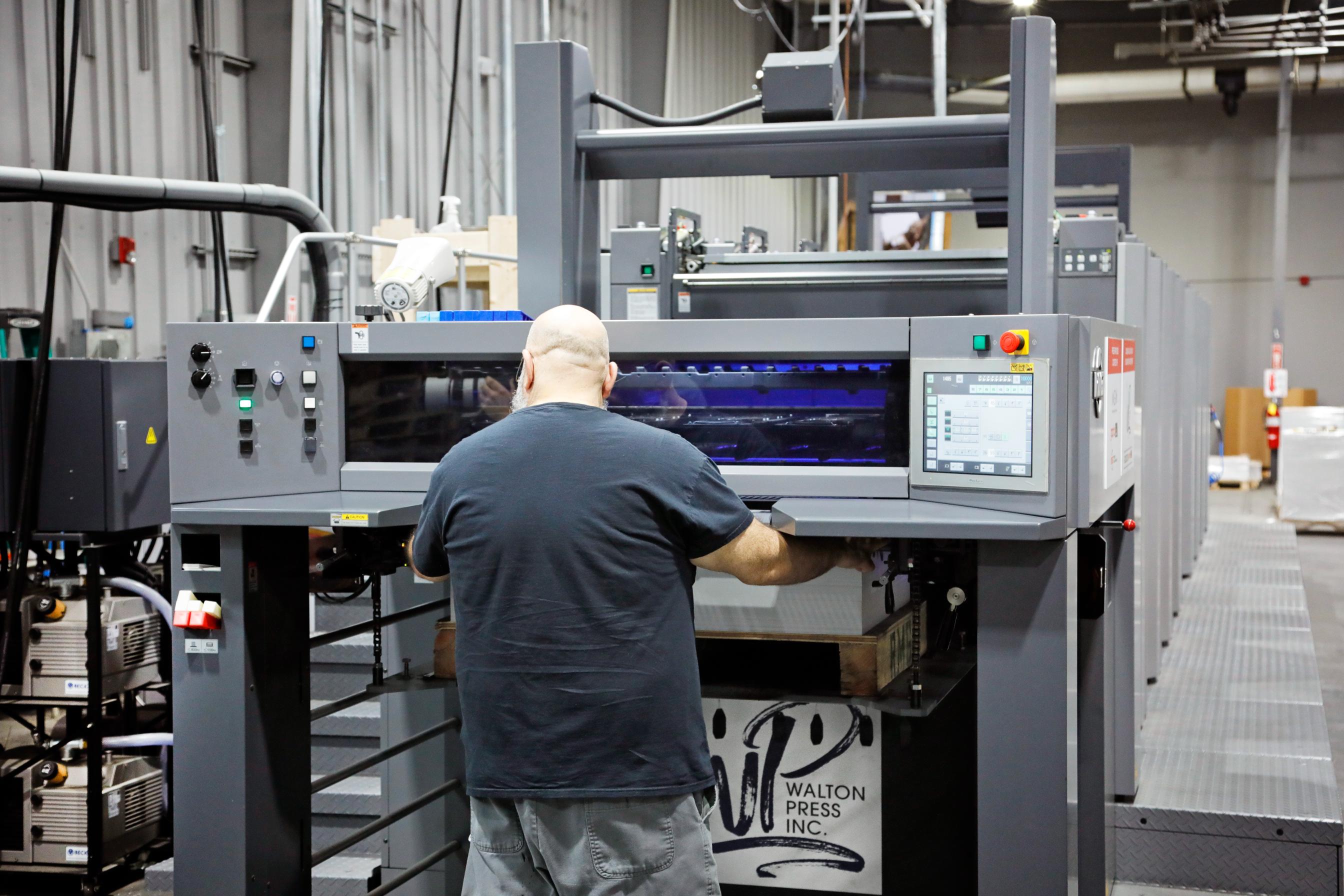
Offset economics now reach further down into short runs than most buyers assume. When Walton Press installed an RMGT 970PF-8+LED Long Perfector, a 25 x 38 inch eight-unit perfecting press running up to 15,000 sheets per hour with LED instant curing, the internal cost study produced a result worth quoting directly.
“That’s a huge twist since our cost study shows runs as short as 500 sheets are actually produced on the new press more cost-effectively than on our digital.”
Stuart Christian, President, Walton Press
That matters for catalog buyers testing a new market or a regional segment. The old rule of thumb, that anything under a few thousand pieces belongs on digital, has moved. Long-perfecting sheetfed presses print both sides in one pass, and LED curing means sheets are dry coming off the press and ready for bindery immediately instead of sitting to cure.
For longer runs, heat-set web is still the answer. Walton Press runs a Manroland ROTOMAN web press rated at 35,000 copies per hour, which is the format catalog and publication printing programs move to once volumes justify it. The full story of that press investment is on our blog: From Germany to Georgia.
Print Catalogs and E-Commerce Are Not in Competition
E-commerce accounted for 16.9 percent of total U.S. retail sales in the first quarter of 2026, on $326.7 billion of online sales against $1,929.0 billion in total retail, according to the U.S. Census Bureau. Online sales grew 9.8 percent year over year. They also still represent under a fifth of where Americans actually spend.
The mail data points the same direction. In the second quarter of fiscal 2026, USPS reported that Marketing Mail revenue rose $210 million, or 5.7 percent, on a volume decline of just 113 million pieces, or 0.9 percent. Compare that to First-Class Mail in the same quarter: revenue down $31 million and volume down 691 million pieces, a 6.3 percent drop. Transactional mail is shrinking fast. Advertising mail is close to flat and generating more revenue per piece.
That gap is the whole argument. Correspondence moved to email. Considered purchasing did not move nearly as completely, because a catalog does something a browser tab cannot: it stays in the room. A buyer at a manufacturing firm in Monroe or a hospitality group in Atlanta keeps a printed line card on the desk for months.
There is a budget reason to move now, too. USPS held Mailing Services prices unchanged in January 2026, with the announced increases landing on shipping products instead, effective January 18, 2026. Flat catalog postage plus a 10 percent promotional discount is a window, not a permanent condition.
A Realistic Catalog Production Timeline
Plan backward from your in-home date, not forward from your kickoff. Catalogs fail on schedule more often than on quality, and almost always because someone treated postal enrollment and list prep as afterthoughts.
A workable sequence for a 32 to 64 page catalog:
| Stage | Working time |
|---|---|
| Content, photography, and copy | 3 to 6 weeks |
| Design and layout | 2 to 4 weeks |
| USPS promotion enrollment and pre-approval | Start here, not later |
| Prepress, proofing, and revisions | 3 to 7 days |
| List acquisition, hygiene, and presort | 1 to 2 weeks, parallel |
| Press and bindery | 5 to 10 working days |
| Mail induction to in-home | 3 to 10 days for Marketing Mail |
Two notes from experience. First, promotion enrollment should begin the day you commit to the project, because pre-approval is not instant and it gates the postage rate. Second, list hygiene runs in parallel with design, not after it. Undeliverable addresses are pure waste: you pay to print, bind, and mail a piece that never arrives.
Tight deadlines are workable. They are just not workable if the postal side starts late.
Catalog Printing in Monroe, Georgia
Walton Press has printed in Monroe, Georgia since 1900, which is more than 125 years of continuous commercial printing in Walton County. That longevity is not a marketing line, it is a production argument: presses, bindery, mailing, and fulfillment services all sit under one roof, so a catalog does not get handed between three vendors and lose a week at each seam.
For businesses across the Atlanta metro and north Georgia, the practical benefit is proximity. Press checks are a drive, not a flight. Drop-shipping to USPS facilities happens from a Georgia plant. And when a catalog program also needs direct mail services, presentation folders, or sell sheets to match, the color matches because it all ran in the same building.
Ready to scope a project? Request a quote on printed catalogs or ask for a sample kit. Walton Press, 402 Mayfield Drive, Monroe, GA 30655. Phone 1-800-354-0235. Email info@waltonpress.com.
Frequently Asked Questions
What is the minimum page count for catalog printing?
Production minimums start at 8 pages for saddle-stitched work, since signatures fold in multiples of 4 or 8. For USPS postage purposes the minimum that matters is 12 pages, because that is the floor for the Catalog Insights Promotion. Below 12 pages you are printing a booklet or a brochure, which is fine, it just will not earn the 10 percent catalog discount.
How much does catalog printing cost per unit?
Unit cost depends on page count, trim size, paper, binding, and quantity, so a single number is misleading. The reliable pattern: unit cost drops sharply between 1,000 and 10,000 pieces as offset makeready spreads across the run, then flattens. Ask any printer for pricing at three quantities rather than one. The curve tells you more than the point.
Is saddle stitching or perfect binding better for a catalog?
Saddle stitching is better under roughly 80 pages: lower cost, faster turnaround, lies flatter. Perfect binding is better above that, and any time you want a printable spine. Both satisfy the “bound” requirement for USPS catalog promotions.
Can a catalog qualify for USPS discounts if it also has editorial content?
Yes, provided it still meets the Catalog Insights requirements: at least 12 pages, bound, a list of products or services with visuals, and enough information to place an order including fulfillment and ordering details. Many successful catalogs are hybrids, mixing brand storytelling with product pages. The product listing and ordering information are what the requirement turns on.
How far in advance should we start a catalog project?
Eight to twelve weeks from kickoff to in-home is realistic for a 32 to 64 page book, and USPS promotion enrollment should start on day one. Rushed schedules are possible on press and in bindery. They are much harder on the postal side, where pre-approval and presort work have their own clock.
Do you print catalogs for businesses outside Georgia?
Yes. Walton Press mails nationally and drop-ships to USPS facilities, so location affects logistics and press-check convenience more than eligibility. Reach out through the contact page to talk through a specific program.
Sources
- U.S. Postal Service, Direct Mail Promotions and Incentives (Catalog Insights Promotion terms, discount percentages, promotion dates, add-on incentives)
- U.S. Census Bureau, Quarterly Retail E-Commerce Sales (Q1 2026: $326.7 billion, 16.9 percent of total retail sales, 9.8 percent year-over-year growth)
- U.S. Postal Service Newsroom, Second Quarter Fiscal Year 2026 Results (Marketing Mail and First-Class Mail revenue and volume)
- U.S. Postal Service Newsroom, New Competitive Prices for 2026 (January 2026 pricing, Mailing Services unchanged)
- U.S. Postal Service Postal Explorer, Business Mail 101: Flats (flat-size physical standards)
Equipment specifications and the cost-study quotation are first-party, drawn from Walton Press production records and previously published company reporting.
About Walton Press. Founded in 1900, Walton Press is a full-service commercial printer in Monroe, Georgia, providing web and sheetfed offset printing, bindery and finishing, direct mail, and fulfillment. 402 Mayfield Drive, Monroe, GA 30655. 1-800-354-0235. info@waltonpress.com.